How to Organize Skincare Products for an Easier Routine
A small tray, a separate place for spares, and a few clear decisions can make your skincare shelf easier to use. Start with what you already own.
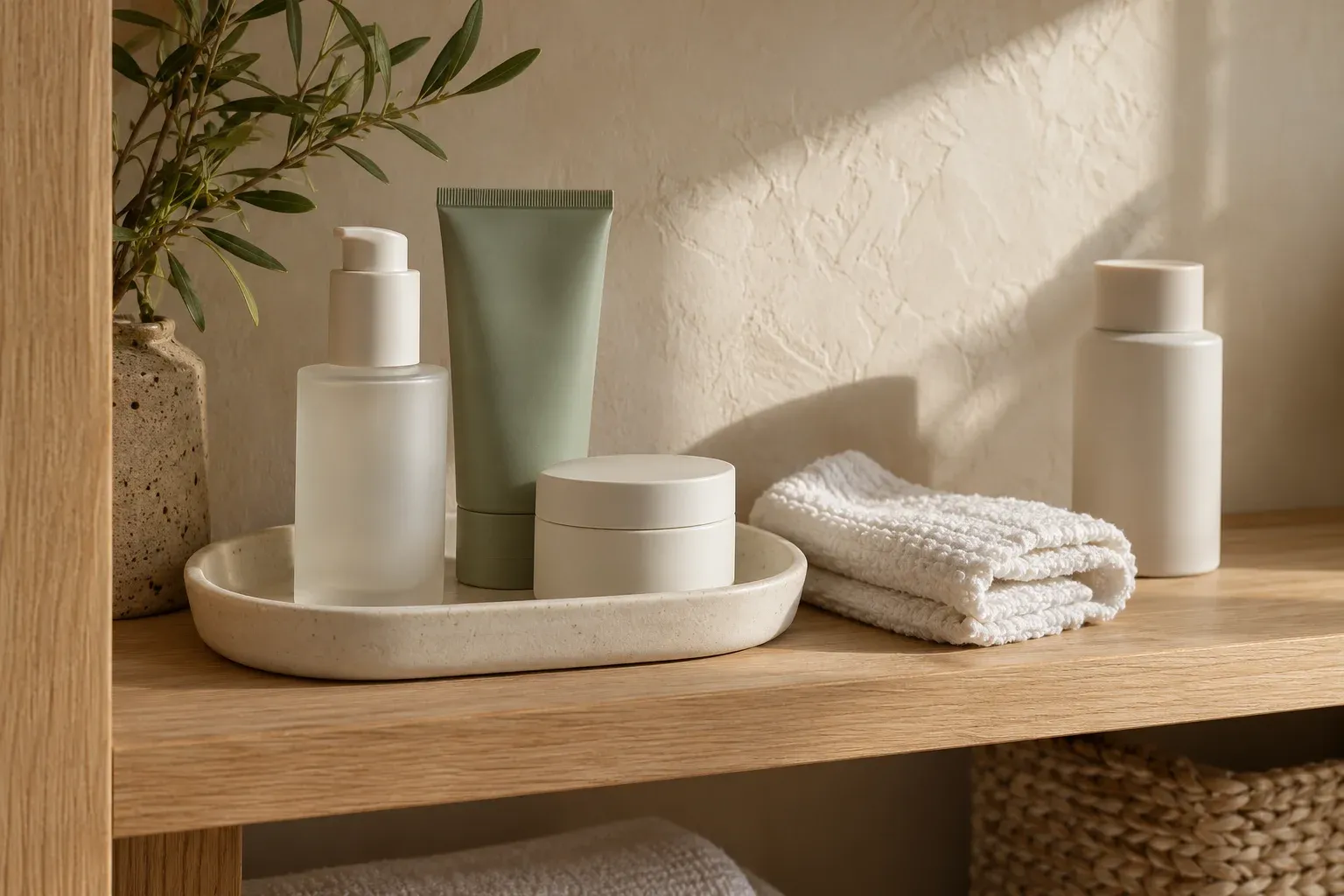
To organize skincare products, separate your daily routine from optional steps and unopened backups, then arrange the daily products in the order you use them. Check labels and dates before putting anything back. A small, easy-to-reach selection is often more useful than a larger display.
Start with the shelf you have. You can decide whether you need a new tray after you’ve found out what actually belongs on it.
Empty one area and make four groups
Work on one shelf, drawer, or toiletry bag at a time. Clearing the whole bathroom at once can leave you with a bigger project than the spare half-hour you had in mind.
Lay down a clean towel and put the products where you can see their labels. Include the bottle beside the sink and the nearly empty tube in your travel bag if they belong to the same routine.
Sort them into four groups:
- Daily use: the products currently in your morning or evening routine.
- Occasional use: optional products you use deliberately, but not every day.
- Unopened backups: replacements for products you already use.
- Needs a decision: unknown opening dates, damaged containers, products you stopped using, or anything you’re unsure about.
The fourth group is temporary. Don’t return it to the back of the shelf just to make the counter look clear. Give each item a decision before considering the job finished.
Read dates before you rearrange
Follow the product’s expiration date, storage instructions, and any after-opening guidance. Note the opening date when you begin a new product so you aren’t trying to reconstruct it months later.
The FDA’s cosmetic shelf-life guidance explains that product life varies with the formula, use, and storage. Heat, sunlight, moisture, and contamination can affect a cosmetic. A changed smell, color, or texture is a reason to stop using it, but looking normal doesn’t confirm that an old product is safe.
For something you can’t date, check with the manufacturer. Don’t invent a universal “one year for everything” rule. Sunscreen deserves its own date check: the American Academy of Dermatology advises replacing expired sunscreen.
If a product irritated your skin and you stopped using it, a tidier shelf isn’t a reason to try it again. Move it out of the daily group and decide how to dispose of the contents and packaging according to local guidance.
Give your everyday products the easiest spot
Put the routine you actually use within comfortable reach. Keep labels facing forward and leave enough room to pick up a bottle without knocking two others over.
You can use one shared tray for morning and evening. If the cleanser and cream are the same for both routines, they don’t need duplicate spaces. Put sunscreen at the daytime end and a separate makeup remover near the cleanser if you use one.
| Group | A practical home | What stays out |
|---|---|---|
| Daily routine | A shallow tray or front of a dry cabinet | Unopened duplicates |
| Optional steps | A small separate basket or drawer section | Products with unclear directions or dates |
| Backups | One labeled box in suitable storage conditions | Several open versions of the same thing |
| Travel items | A pouch you check before each trip | Unidentified decanted leftovers |
This is an arrangement suggestion, not a requirement to buy four containers. A small drawer can hold the same groups with space between them. Start by moving things, then see where a divider would help.
Arrange by use order, with directions in charge
Use routine order as the organizing principle rather than bottle height or packaging color. You’ll spend less time deciding what comes next when the sequence is visible.
The skincare routine order guide explains the usual morning and evening steps. Product-specific directions still come first. An optional product doesn’t become essential just because there is a space for it on the tray.

If you already use RENU Advanced, group its cleanser, toner, serum, and cream together in their use order. Keep your separate sunscreen nearby for daytime. The RENU Advanced guide is useful for checking the sequence, while skincare sets vs. individual products can help if you’re deciding which approach fits your shelf.
Leave enough space to read a label when you need it. A rotating organizer can look tidy, but it isn’t useful if tall bottles hide the smaller products or every morning starts with searching.
Choose the storage spot before the organizer
Follow the storage conditions on each label, and avoid a position in direct sun, next to a heater, or under repeated shower spray. Keep containers closed and applicators clean. The FDA notes that bathroom moisture and heat can affect cosmetics, so the prettiest windowsill may not be the best home for your routine.
If your bathroom stays damp, consider a suitable dry cabinet elsewhere. You can carry a small tray to the sink and put it away afterward. Keep products out of reach of children and pets.
A fridge isn’t a general storage upgrade. Use refrigeration only where the manufacturer directs it rather than assuming it extends the life of every product. The label is more useful than a storage trend.
Keep a short replacement list
Make a note of unopened backups before buying more. A simple list with product name, number of spares, and any relevant dates is enough.
For example, “Cleanser: one open, one sealed” is easier to act on than a vague memory that you might have another bottle somewhere. When the open one is finished, move the spare forward and update the list.
Keep different products separate in your planning. A cleanser and a serum may not run out together, even if you bought them on the same day. If you use repeat deliveries, compare the next order with the products you have rather than assuming the whole set needs replacing. The one-time purchase vs. subscription guide covers that decision.
Make the reset easy to repeat
Choose a small recurring cue, such as changing your hand towel, to wipe the tray and put stray products back. This is a household habit, not a product shelf-life rule. You still follow each label’s dates and storage advice.
During that quick reset, check three things: can you find the next step, is anything nearly empty, and has an undecided product crept back into daily use? Deal with those before adding another organizer.
You can keep a handwritten morning and evening sequence inside the cabinet door, or use the simple routine checklist. The useful result is a shelf where you can find what you need, put it back, and get on with your day.